
Wastewater Treatment Plant

Wastewater is used water. It includes human waste, food grains, oils, soaps, and chemicals. Used water from home includes water from sinks, toilets, bathroom and washing machines etc. Businesses and industries also contribute their share of used water that must be cleaned. Industrial wastewater contains specific pollutants depending on the nature of the industrial activity.
Wastewater treatment is the process of converting wastewater (water that is no longer needed or is no longer suitable for use) into water that can be discharged back into the environment. Wastewater is full of contaminants including bacteria, chemicals, and other toxics. The treatment aims at reducing the contaminants to acceptable levels and make it safer.
Sewage Treatment Plant
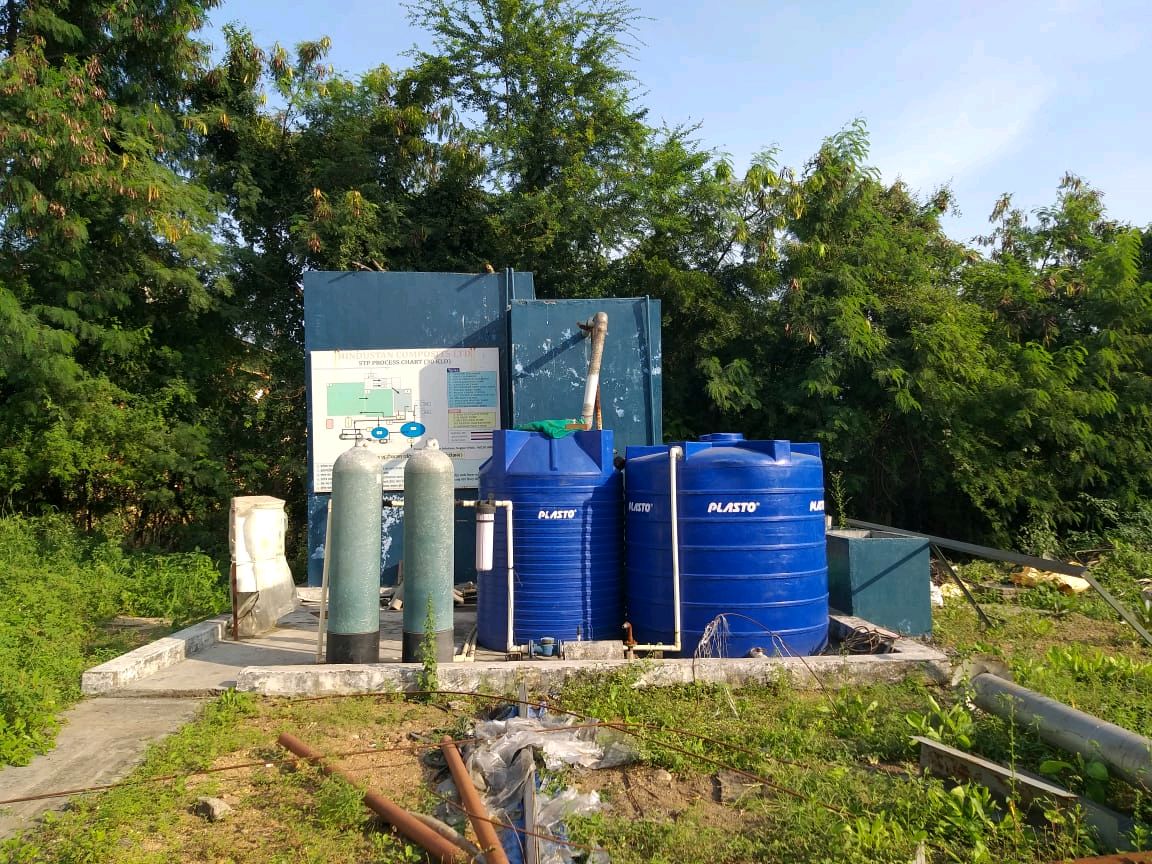
Though sewage or effluent is dirty, it is still a permanent source of water. If treated properly, these water sources can very well satisfy our maximum need of non potable water requirements.
Sewage treatment is the process of removing contaminants from municipal wastewater, containing mainly household sewage plus some industrial wastewater. Physical, chemical, and biological processes are used to remove contaminants and produce treated wastewater (or treated effluent) that is safe enough for release into the environment. A by-product of sewage treatment is a semi-solid waste or slurry called sewage sludge. The sludge has to undergo further treatment before being suitable for disposal.
Sewage treatment may also be referred to as wastewater treatment. However, the latter is a broader term which can also refer to industrial wastewater. For most cities, the sewer system will also carry a proportion of industrial effluent to the sewage treatment plant which has usually received pretreatment at the factories themselves to reduce the pollutant load. If the sewer system is a combined sewer then it will also carry urban runoff (stormwater) to the sewage treatment plant. Sewage water can travel towards treatment plants via piping and in a flow aided by gravity and pumps. The first part of filtration of sewage typically includes a bar screen to filter solids and large objects which are then collected in dumpsters and disposed of in landfills. Fat and grease is also removed before the primary treatment of sewage.
Effluent Treatment Plant (ETP) and Zero Liquid Discharge Plant (ZLD)
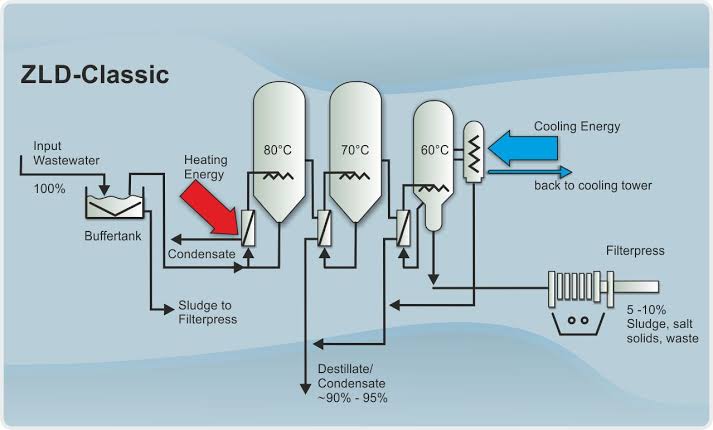
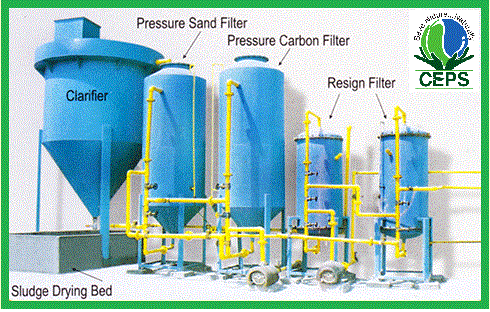
Being a quality centric organization, we are able to offer our clients effluent treatment plant of utmost quality. These plants are manufactured by our professionals in compliance with defined standards, using premium quality raw material sourced from reliable vendors of the market as per the defined industry standards and customized depending upon the need of the clients. Depending upon the constituents of wastewater, physical and chemical treatment processes are selected. It is followed by biological treatment. It contains organic wastes which sometimes require water softening or reverse osmosis (RO) and multi effect evaporator along with regular tertiary treatment. Obviously, provision of softener, RO and MEE converts the ETP into zero liquid discharge (ZLD).
Effluent Treatment Plant for Hospitals (ETP)
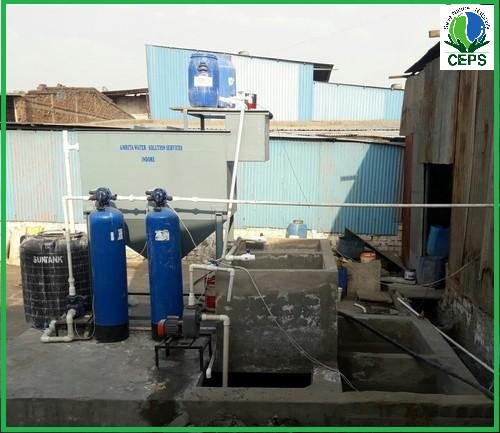
Hospitals generate tremendous effluent from operation theatres, pathology laboratories, linen washings, labour rooms, cath labs, dialysis, radiologies and others processes. It may contain potentially hazardous components including microbiological pathogens, radioactive isotopes, disinfectants, sterilizers, drugs and their metabolites etc. besides blood and other body fluids.
We provide state of the art ETP for the same. It is based on microbial oxidation of organic compounds, strong disinfection, and oxidation by ozone gas followed by filtration. It ensures better quality treated water and compliance with environmental rules.
Technologies for treatment of sewage and organic effluent
1. Activated Sludge Process (ASP)

The activated sludge process is a type of wastewater treatment process for treating sewage or industrial wastewater using aeration and a biological floc composed of bacteria and protozoa.
The general arrangement of an activated sludge process for removing carbonaceous pollution includes the following items, an aeration tank where air (or oxygen) is injected in the mixed liquor. This is followed by a settling tank (usually referred to as “final clarifier” or “secondary settling tank”) to allow the biological flocs (the sludge blanket) to settle, thus separating the biological sludge from the clear treated water.
The activated sludge process (ASP) is a sewage treatment process in which air or oxygen is blown into the raw, unsettled sewage to smash the solids and develop a biological ‘soup’ which digests the organic content and pollutants in sewage.
2. Moving Bed Bio Reactor (MBBR)
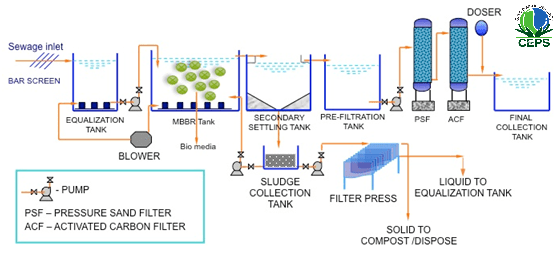
The Moving bed Bioreactor (MBBR) is an economical solution offered for wastewater treatment if the pollution load is in “bulk”.
With this application, we offer advanced wastewater treatment solutions for the industrial and municipal markets. These solutions significantly increase the capacity and efficiency of existing wastewater treatment plants, while minimizing the size of new plant deployments. This method makes it possible to attain good efficiency results of disposal with low energy consumption. This process is used for the removal of organic substances, nitrification and denitrification.
The MBBR system consists of an activated sludge aeration system where the sludge is collected on recycled plastic carriers. These carriers have an internal large surface for optimal contact water, air and bacteria.
The bacteria/activated sludge grow on the internal surface of the carriers. The bacteria breaks down the organic matter from the waste water. The aeration system keeps the carriers with activated sludge in motion. Only the extra amount of bacteria growth, the excess sludge will come separate from the carriers and will flow with the treated water towards the final separator.
The system can consist of a one stage or a multiple stage system depending on the specific demand. The specific bacteria remains in their own duty tank because of the fact that the carriers remain in only one tank, protected by screens.
3. Review of Treatment Technologies
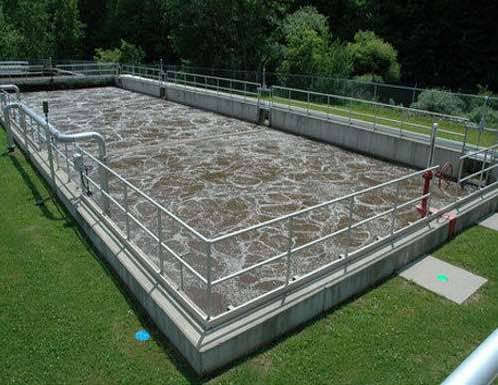
The Objective of STP is to stabilize decomposable organic matter present in raw sewage and suspended solids in trade of effluent so as to produce an effluent water and sludge which can be disposed off in the environment without causing pollution, health hazards, and nuisance.
The following biological (Secondary) processes are available for the treatment of raw sewage:
- Phytorid technology
- Extended Aeration (EA)
- Moving Bed Bioreactor (MBBR)
- Sequence Batch Reactor (SBR)
- Above all processes are analyzed to evaluate the treatment process. As per analysis provided. Following are the key points for processes selection:
- Phytorid technology has minimum operation cost compared to all other technologies of sewage treatment, but the capital cost of area required is highest.
- Capital Costs for STP with Extended Aeration and MBBR is almost the same whereas for STP with SBR, the cost is relatively more.
- Power cost of extended Aeration is more as compared to MBBR, while for SBR. It is comparatively less and for MBR, the power cost is the highest.
- Operation & Maintenance cost is marginally higher for MBR as compared to the other three alternative.
- Area requirements for MBR is less as compared to that required for other three alternatives. Further, Tertiary Treatment is not required for MBR as treated water quality is better than other technologies.
- Considering criteria such as area requirement, operating flexibility, cost comparison, better quality of effluent, and reuse of treated wastewater for selection of suitable process for biological treatment. It is recommended to provide MBBR based STP for the proposed project.